@GregAlexandre
Hi, thank you for reporting this. It has been fixed.
Let us know if you still encounter issues.
 R
Offline
R
Offline
-
RE: "Copilot" path not embedded in Edge
-
TightVNC - Install, Upgrade
TightVNC can be upgraded using the Custom Software feature in VulnDetect - Corporate:
https://corporate.vulndetect.com/#/deployment/custom-create-jobDownload the latest installers from the official website:
https://www.tightvnc.com/download.htmlThe parameters used in this guide are present in TightVNC's official documentation:
https://www.tightvnc.com/doc/win/TightVNC_2.7_for_Windows_Installing_from_MSI_Packages.pdfTo install TightVNC with its default settings use /quiet /norestart, this will install (or upgrade) both Viewer and Server.
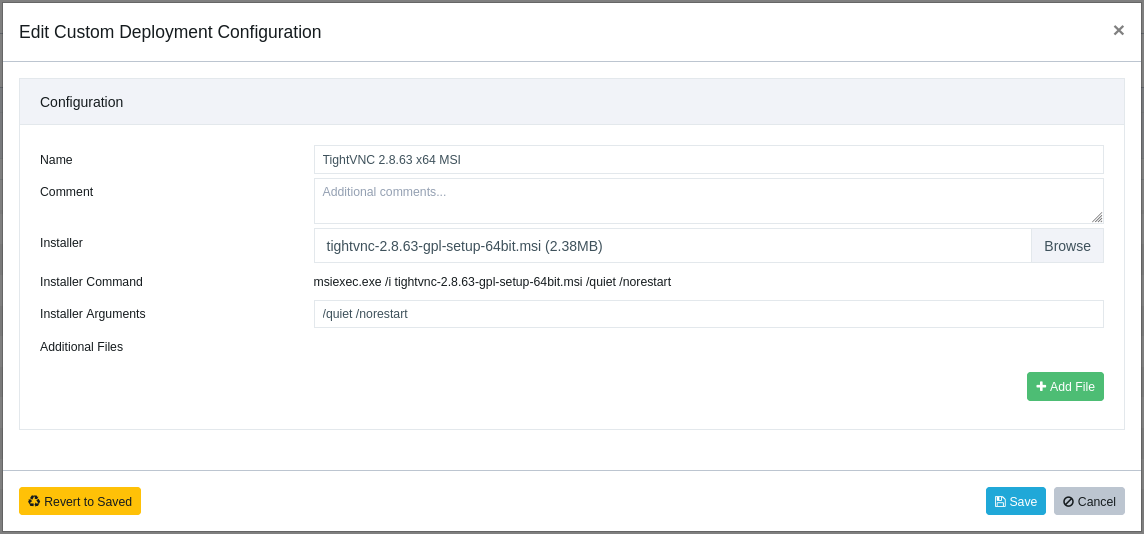
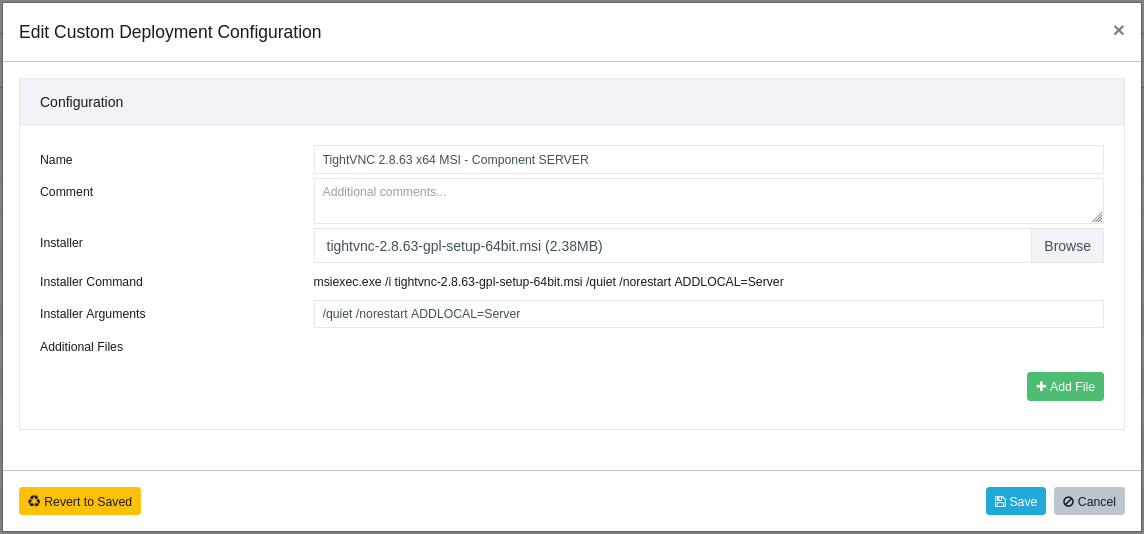
If you would like to install a specific component of TightVNC, use the standard MSI property
named ADDLOCAL. The following three commands install only the server part, only the client part
and both parts, correspondingly:• msiexec /i tightvnc-2.8.63-gpl-setup-64bit.msi /quiet /norestart ADDLOCAL=Server • msiexec /i tightvnc-2.8.63-gpl-setup-64bit.msi /quiet /norestart ADDLOCAL=Viewer • msiexec /i tightvnc-2.8.63-gpl-setup-64bit.msi /quiet /norestart ADDLOCAL="Server,Viewer"Note that running the installer with e.g., ADDLOCAL=Server, on a system with both Viewer and Server, will remove the Viewer.
TightVNC with the Server component only.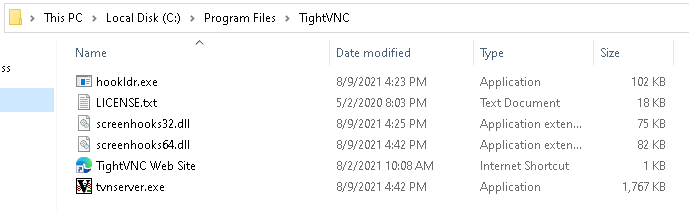
-
Patching Autodesk Revit using Custom Tag Approvals
Autodesk Revit updates can be handled through Custom Tag Approvals, where customers upload the required Revit update files themselves.
We have used the following custom configuration:
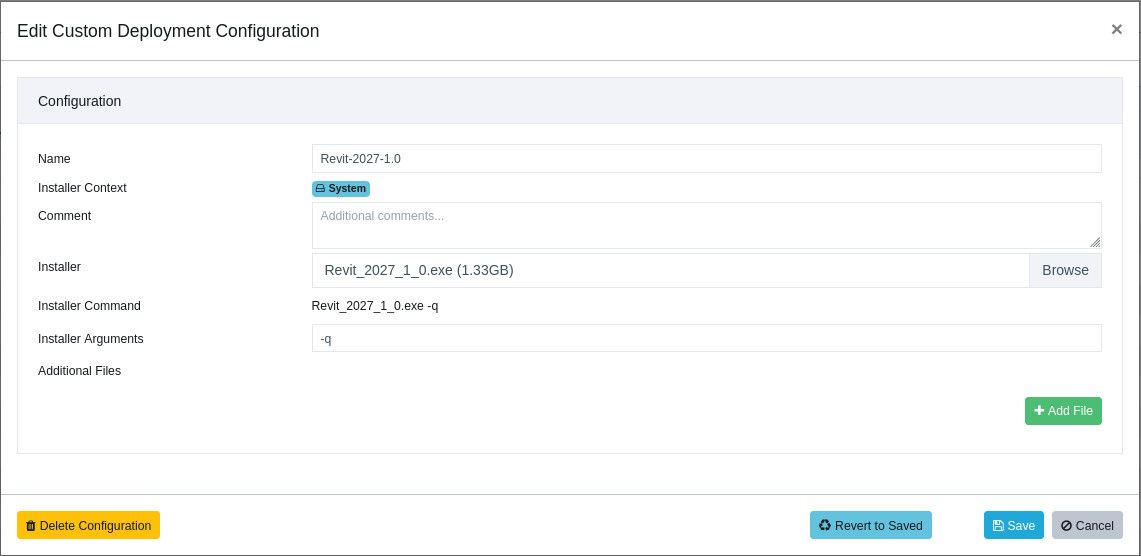
- Download the required Revit update file from your Autodesk account.
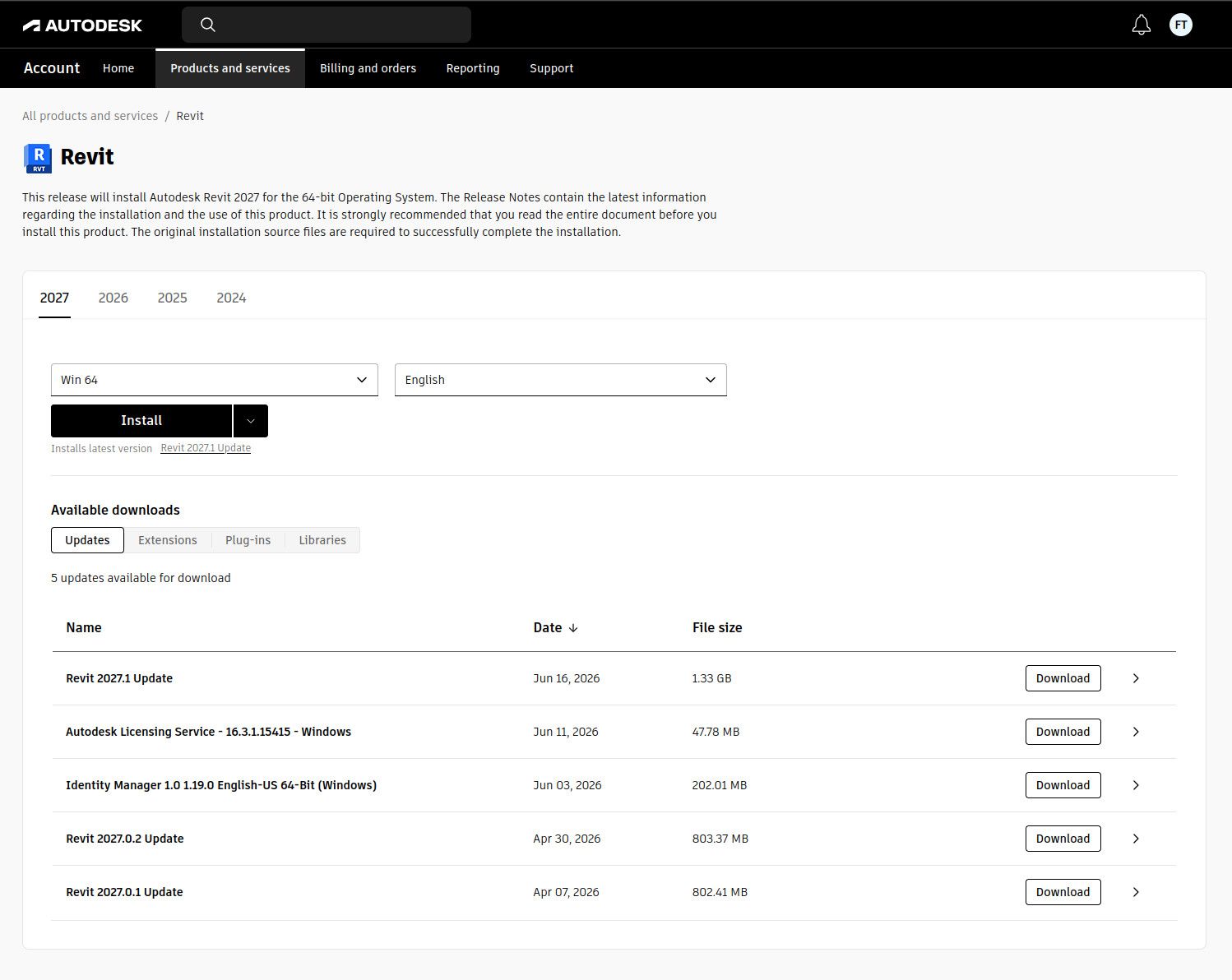
- Upload the update file to the relevant Custom Tag Approval in VulnDetect by enabling customization

- Assign the custom tag to the hosts where Autodesk Revit should be updated.
- VulnDetect will deploy the uploaded update file to the tagged hosts on the next inspection.
Please make sure the uploaded update file matches the Revit version installed on the target hosts, as Autodesk updates are usually specific to a product and version branch.
This approach can be used to keep Revit updated through VulnDetect by maintaining the update files directly on the Custom Tag Approval.
- Download the required Revit update file from your Autodesk account.
-
RE: "Copilot" path not embedded in Edge
@GregAlexandre
Hi, thank you for reporting this. It has been fixed.
Let us know if you still encounter issues. -
Battle-net - Custom Software removal
Because the Battle.net uninstall string does not support silent parameters, we created a PowerShell script that removes the application completely, including any leftover files and registry entries.
1. Save the removal script as a .ps1 file, for example
remove-battlenet.ps1$processNames = @("Agent", "Battle.net") $pathsToRemove = @( "$env:LocalAppData\Battle.net", "$env:LocalAppData\Blizzard Entertainment", "$env:AppData\Battle.net", "$env:ProgramData\Battle.net", "${env:ProgramFiles(x86)}\Battle.net", "$env:ALLUSERSPROFILE\Microsoft\Windows\Start Menu\Programs\Battle.net*", "$env:PUBLIC\Desktop\Battle.net.lnk" ) $registryPaths = @( "HKLM:\SOFTWARE\Wow6432Node\Microsoft\Windows\CurrentVersion\Uninstall\Battle.net" ) function Test-BattleNetPresent { foreach ($proc in $processNames) { if (Get-Process -Name $proc -ErrorAction SilentlyContinue) { return $true } } foreach ($path in $pathsToRemove) { if (Test-Path $path) { return $true } } foreach ($regPath in $registryPaths) { if (Test-Path $regPath) { return $true } } return $false } function Remove-PathIfExists { param ( [string]$Path ) if (Test-Path $Path) { Remove-Item $Path -Recurse -Force -ErrorAction SilentlyContinue Write-Host "Removed: $Path" } else { Write-Host "Not found: $Path" } } function Remove-RegistryIfExists { param ( [string]$RegistryPath ) if (Test-Path $RegistryPath) { Remove-Item $RegistryPath -Recurse -Force -ErrorAction SilentlyContinue Write-Host "Removed registry key: $RegistryPath" } else { Write-Host "Registry key not found: $RegistryPath" } } if (-not (Test-BattleNetPresent)) { Write-Host "Battle.net is not installed or no related files were found. Nothing to do." exit 0 } Write-Host "Battle.net detected. Starting cleanup..." foreach ($proc in $processNames) { $running = Get-Process -Name $proc -ErrorAction SilentlyContinue if ($running) { Stop-Process -Name $proc -Force -ErrorAction SilentlyContinue Write-Host "Stopped process: $proc" } else { Write-Host "Process not running: $proc" } } foreach ($path in $pathsToRemove) { Remove-PathIfExists -Path $path } foreach ($regPath in $registryPaths) { Remove-RegistryIfExists -RegistryPath $regPath } Write-Host "Cleanup complete." exit 0This PowerShell script:
- stops Battle.net-related processes if they are running
- checks whether Battle.net or related leftovers exist
- removes known Battle.net folders
- removes Start Menu and Desktop shortcuts
- removes the uninstall registry key
- exits cleanly if nothing is found
2. Create a tag for Battle.net hosts
For easier targeting, you can create a dedicated tag for hosts with Battle.net installed
https://corporate.vulndetect.com/#/tags
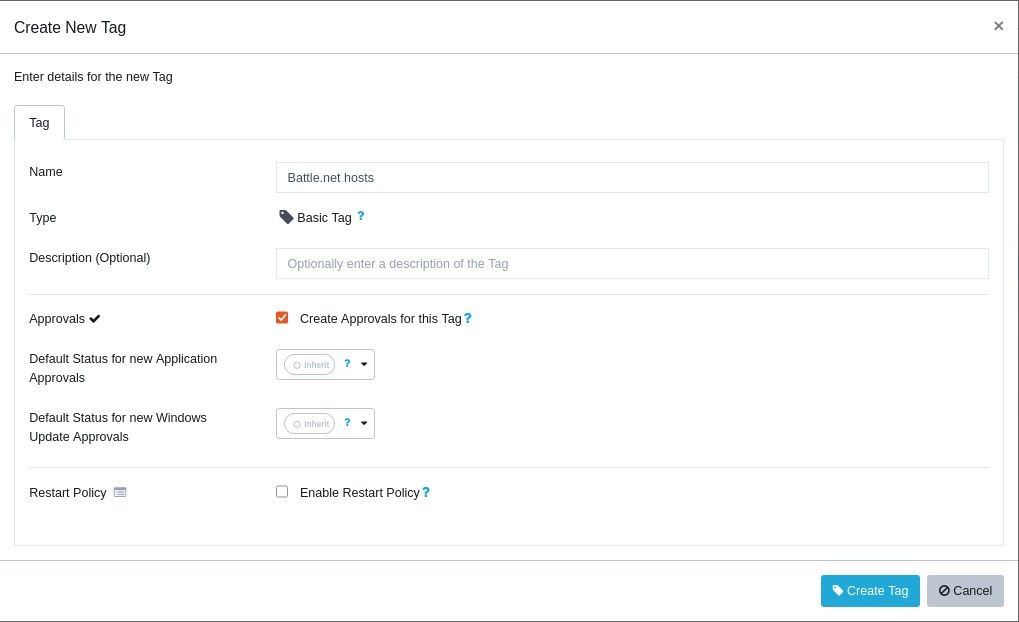
3. Filter hosts from the Applications page
From the Applications page, filter the hosts with Battle.net installed and assign the tag to them.
https://corporate.vulndetect.com/#/applications4. Create the Custom Software deployment
Create the custom configuration and upload the removal script as a
.ps1file
https://corporate.vulndetect.com/#/deployment/custom-create-job
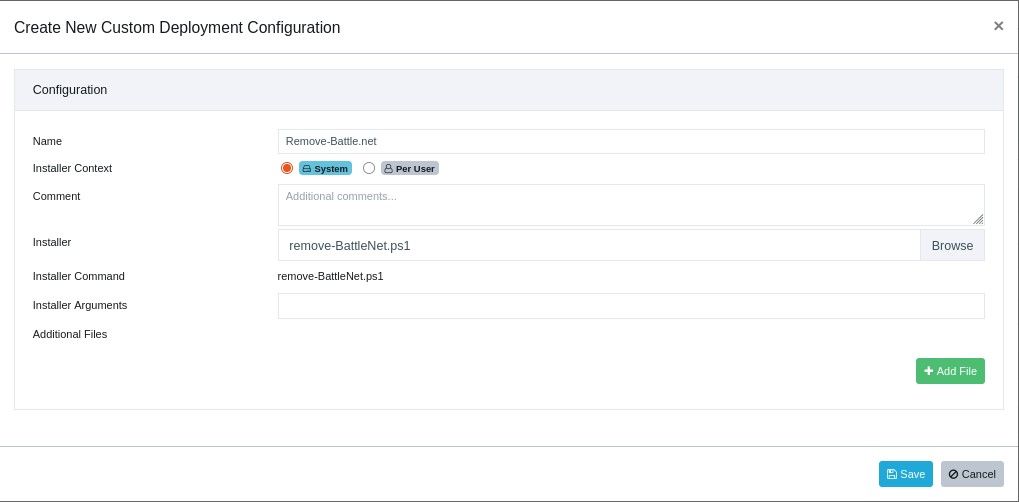
5. Deploy the Custom Deployment Job to the target tag
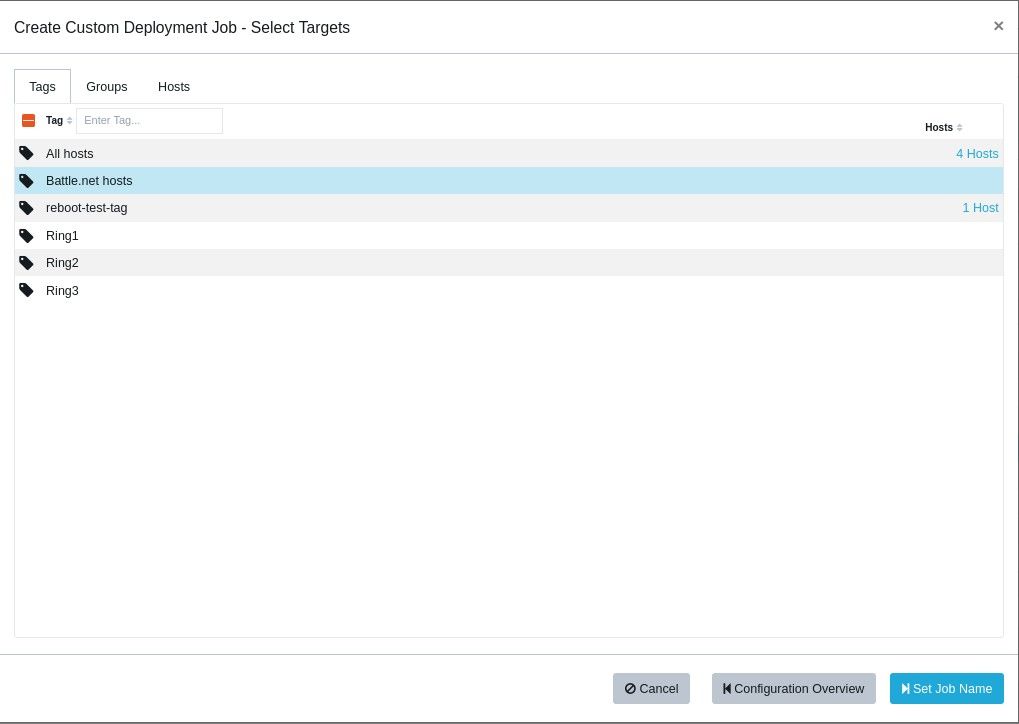
Run a manual inspection after deployment if you want the results to appear immediately. -
Adobe Creative Cloud suite - Install, Upgrade
Adobe Creative Cloud Custom Patching Now Available via Custom Tag Approvals
We’re happy to announce that custom patching for Adobe Creative Cloud is now supported through Tag Approvals.
This allows you to deploy and update Adobe Creative Cloud and Adobe Creative Cloud applications using the official deployment packages generated in the Adobe Admin Console:
https://helpx.adobe.com/enterprise/using/admin-console.htmlRequirement:
Creating deployment packages from the Adobe Admin Console requires an Adobe Enterprise license. Once created, upload the customized Adobe ZIP package directly into the Custom Tag Approval to manage installations and updates across hosts.Example: Custom Tag Approval

How to use this feature
1. Create a package in the Adobe Admin Console using your Enterprise license. The Adobe deployment ZIP package will automatically download once the package is generated.

2. Upload the Adobe Creative Cloud ZIP package to your Custom Tag Approval and configure the required silent install parameter:
--silentYour Custom Tag Approval configuration should look similar to the following:
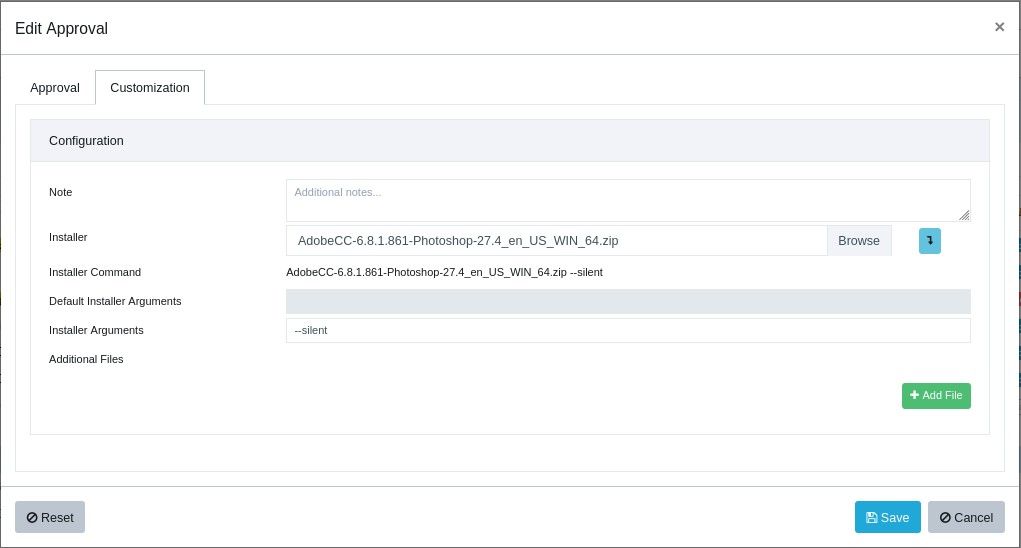
Keep in mind that Adobe packages can be large, which may increase upload time depending on your network connection.3. Save the approval and inspect your hosts.
Important Notes
- You can include multiple Adobe applications in your custom deployment ZIP.
- Patching will only occur when a new version of Adobe Creative Cloud is detected.
For Custom Software deployment of Adobe Creative Cloud, see:
https://vulndetect.org/topic/2385/adobe-creative-cloud-install-upgrade -
OneDrive Patch: Why SecTeer’s Recommended Version Is "old"
SecTeer VulnDetect recommends an "old" patch for OneDrive e.g. 25.184.921.4 (at the time of writing) as the latest available/recommended patch because this is the version that Microsoft makes available on their official download channels.
https://www.microsoft.com/en-us/microsoft-365/onedrive/downloadSome hosts already show a higher installed version, e.g. 25.206.1021.3.
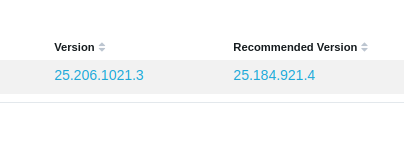
That can look a bit odd because the “recommended” version may appear lower than what you already have. This is happening because the OneDrive client will auto-update itself shortly after.SecTeer will continue to show e.g. 25.184.921.4 as the latest available patch until Microsoft publishes a newer build as the default downloadable installer. The same is the case for certain other Microsoft products such as 365 Apps and Edge too, where Microsoft tend to release some undocumented pre-release versions or at least versions that aren't available for download via the usual official sources.
We plan to release and maintain OneDrive patches as soon as a build is officially available for download.
-
CCleaner 7.x Installer Behavior Change Notice
Starting with the 7.x release, the new CCleaner installer now triggers a Windows UAC prompt even when executed from an elevated context (such as Administrator or SYSTEM).
To accommodate this, the patch will still be made available as Non-Silent and marked with a special indicator to alert users:
This indicator helps ensure that users are aware of the expected UAC prompt before enabling the approval.Additionally, the language parameter previously supported by SecTeer (based on Piriform’s official documentation) no longer functions as of version 7.x.
Our tests confirm that:- The /L=<languageCode> argument is ignored by the 7.x installer
- The installer now defaults to English, regardless of the parameter specified
This means that localized installations are no longer possible. The patch will revert the application interface back to English until the vendor restores multi-language support.
Thank you for your understanding.
-
Adobe Acrobat Printing Issue in Latest Release
We want to make you aware of a known issue affecting the latest Adobe Acrobat/Reader update (version 25.001.20744).
This release has introduced significant printing problems, which are impacting a wide range of users.Adobe has confirmed the root cause of the issue and is working on a fix, expected in an upcoming Quick Fix Engineering (QFE) release. You can follow the official discussion here:
https://community.adobe.com/t5/acrobat-reader-discussions/failure-to-print-since-update-to-2025-001-20744/m-p/15524749Recommendation
Until Adobe provides a patch, we recommend avoiding the latest update and continuing with the previous stable version instead.
SecTeer has already adjusted the patching mechanism so this recommendation is automatically applied.We have tested downgrading directly from version 25.001.20744 using the prior MSP package. Unfortunately, this method does not successfully roll back the update.
The only reliable method is to uninstall the current version, reinstall the previous stable version, and then disable automatic updates until Adobe publishes a fix.
Thank you for your patience and understanding.
-
Zoom Workplace 32-bit going EoL on December 2025
Hi,
Due to Zoom phasing out support for Windows 32-bit by December 2025, all upgrades for 64-bit OS's will be done using the 64-bit installer.
For more details, please refer to the official vendor announcement:
https://support.zoom.com/hc/en/article?id=zm_kb&sysparm_article=KB0079569 -
reMarkable - Upgrade
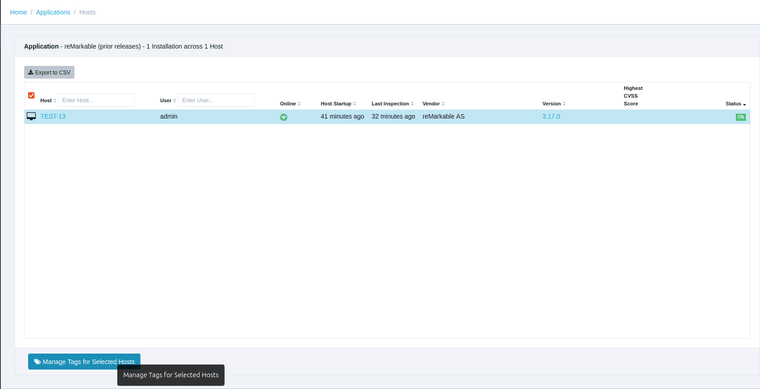
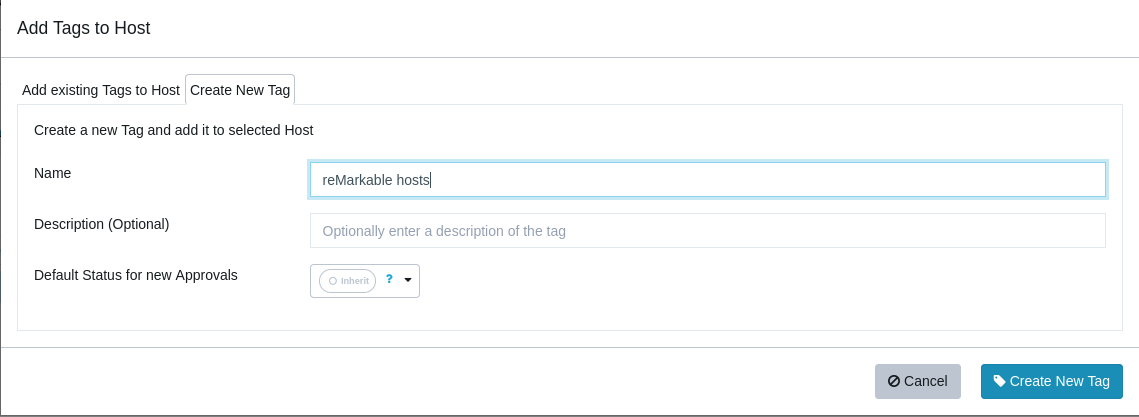
1. Create a tag for all hosts with reMarkable installed
From the Applications page, click on the result under the Installations column to view hosts with reMarkable (prior releases) installed and use the
Manage Tags for Selected Hostsbutton to create the new tag.
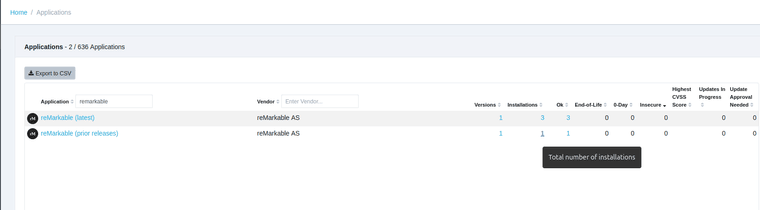
2. Uninstall Prior Versions
Using the Software Deployment feature, apply the reMarkable (prior releases) uninstall and reMarkable (latest) deployment jobs to the tagged hosts.
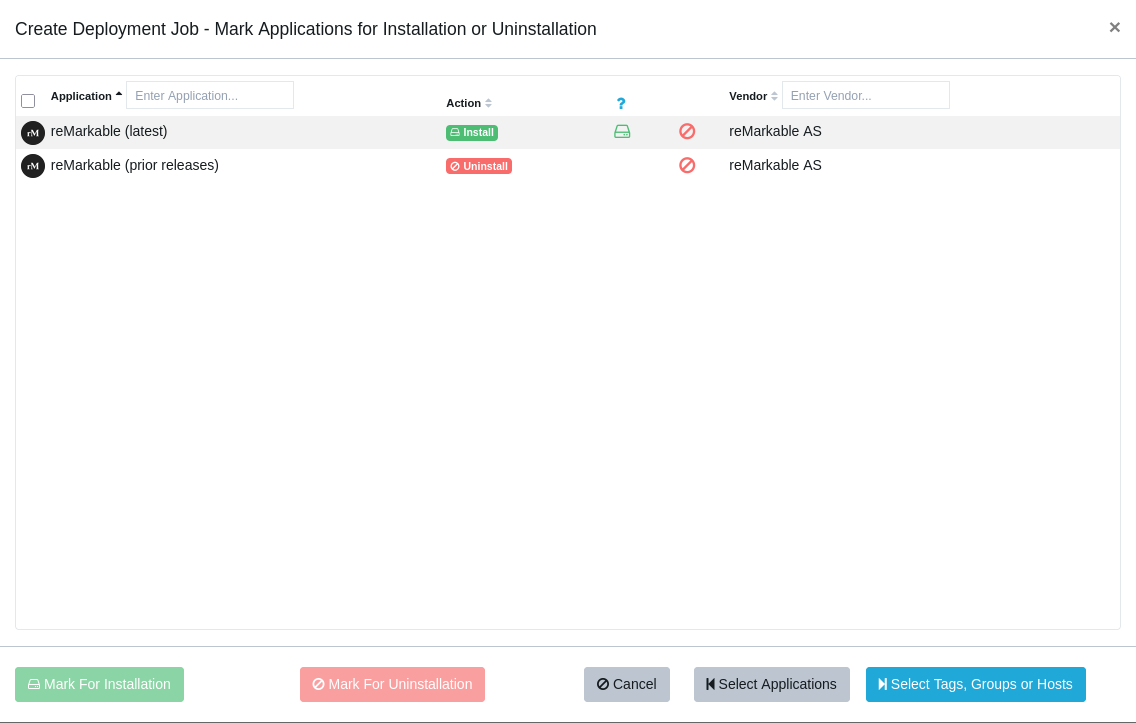
Additional inspections might be required for the job to fully complete. -
VLC EXE/MSI - how to "switch" installers
Note: VLC now ships the MSI again, we have re-enabled support for updating MSI based installations. The below is kept for those who wants to change installers, as well as an example of how to do similar things for other applications.
Hi,
If you're experiencing issues with VLC not updating, this may be because the vendor stopped creating MSI installers as of version (3.21). We rely on official vendor installers and will update our package as soon as the MSI becomes available.
You can follow the official discussion thread here for more details:
https://forum.videolan.org/viewtopic.php?f=14&t=164735&p=544928&hilit=msi#p544928To help differentiate between installer types, we've updated VLC's title to clearly indicate whether it's an MSI or EXE installer:
VLC media player (EXE)
VLC media player (MSI)
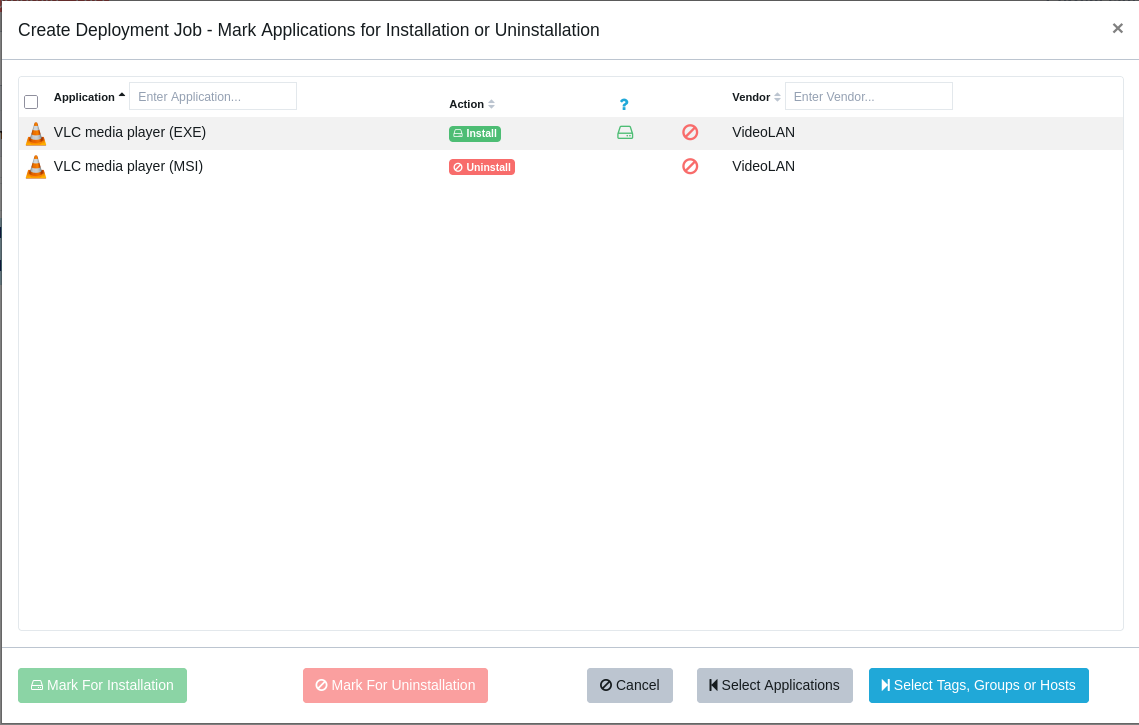
To switch your MSI installation to the EXE version, use the Software Deployment feature to create a combined job that removes the MSI and deploys the EXE version simultaneously: